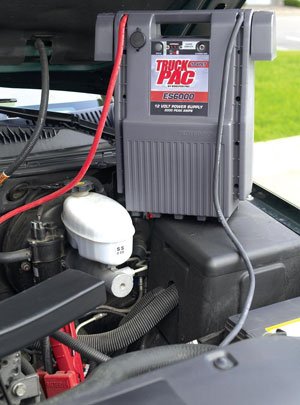
Truck PAC ES6000 Review: Heavy-Duty 12V Starting Without the Hype
Already think this is the right fit?
If the quick answer above matches what you need, you can check current availability now. Keep reading if you want the specifications, trade-offs, compatibility notes and evidence behind the recommendation.
Affiliate disclosure: If you buy through one of these Amazon links, JumpStarterReviews may earn a commission. As an Amazon Associate I earn from qualifying purchases. It does not increase the price you pay.
Availability, seller, bundle and price can change. Confirm the exact model and included accessories before ordering.
The ES6000 is easy to misunderstand if you compare it with pocket-size lithium jump starters by headline amp numbers alone. It was designed for a different job: repeated, high-demand 12V starting in environments such as diesel service, municipal fleets, farms, construction and marine service.
Truck PAC ES6000 at a glance
| System voltage | 12V only |
|---|---|
| Published ratings | 3,000 peak amps; 800 cranking amps |
| Battery system | Dual ES Series batteries designed for jump starting |
| Cable length | 54 inches |
| Cable gauge | #4 AWG |
| Clamps | Industrial-grade Hot Jaw clamps |
| Charging | Automatic recharging |
| Status display | LED battery-status indicator |
| Accessory power | 12V DC outlet |
| Weight | 41 lb |
| Warranty | One-year limited warranty |
Evidence note: JumpStarterReviews has not physically tested this exact ES6000 for this rebuild. Specifications and operating guidance here come from current Clore Automotive product information and the current operator instructions. Manufacturer performance statements remain manufacturer claims, not JSR measurements.
Who should consider the ES6000?
The natural buyer is someone who repeatedly deals with large 12V starting systems and values reserve capacity, long cables and service-style construction more than portability.
Best fit
Fleet garages, farms, diesel service, construction equipment, marine service and other environments where a jump starter may be used repeatedly and a 41-lb tool is acceptable.
Probably too much tool
For an ordinary passenger car that needs an occasional emergency jump, the ES6000 is usually far heavier and bulkier than necessary. A smaller 12V lead-acid unit or an appropriate lithium pack is easier to store and carry.
Why 800 cranking amps tells us more than “3,000 peak” alone
Clore publishes both figures. The 3,000 peak-amp number is prominent, but the 800 cranking-amp rating gives useful additional context. Cross-brand peak-amp claims are not a sufficient basis for choosing a jump starter.
The ES6000 also uses two ES Series batteries specifically designed for vehicle jump starting. Clore positions that battery reserve for repeated starts and extended cranking demands. We have not independently measured how many starts it will deliver under a particular temperature, engine or battery condition, so we do not assign it a made-up universal number.
The 54-inch cables matter on large equipment
Large trucks and machinery do not always give you a convenient place to set a jump box. The ES6000's 54-inch #4 AWG welding-cable leads provide useful placement flexibility, while the industrial Hot Jaw clamps are designed for strong contact and power transfer.
That cable reach is one of the practical reasons to consider a service-style unit instead of assuming the smallest jump starter is automatically the most convenient.
Automatic charging supports an always-ready shop role
The ES6000 includes automatic recharging and LED battery-status indicators. Clore says its charging circuitry allows the unit to remain connected to its charger without overcharging, which fits a fleet or shop routine where readiness matters more than portable-device features.
Quick Car Tip
Recharge a jump starter after use rather than waiting for the next emergency to discover it is low. Also inspect the case, cables and clamps periodically. Readiness is part of the equipment, not an optional extra.
ES6000 versus a dual-voltage jump starter
The ES6000 is deliberately a 12V machine. That is a strength when every vehicle or piece of equipment you service is 12V because there is no 24V operating mode to select accidentally.
If your work genuinely includes both 12V and 24V systems, a dual-voltage unit such as the Truck PAC ES1224 or Jump-N-Carry JNC1224 is the appropriate category to investigate instead. Do not buy a 12V-only unit and improvise around a 24V system.
Critical voltage rule
The ES6000 is a 12-volt jump starter. Clore warns never to connect a 12V DC power source to a 24V vehicle because the mismatch can create dangerous overcharging and explosive gas. If you cannot positively confirm the disabled system is 12V, do not connect the ES6000.
Weight is the biggest everyday trade-off
At 41 lb, the ES6000 asks something of its owner that a small lithium pack does not. Think about who will lift it, where it will be stored, how far it may need to be carried and whether a large jump box can be positioned safely around the equipment.
| What the design gives you | What you accept |
|---|---|
| Heavy-duty 12V starting role | 41-lb carrying weight |
| Dual jump-starting batteries | Large physical footprint |
| 54-inch cable reach | Less convenient for a small trunk |
| Automatic charging | Traditional design rather than USB-focused electronics |
| Industrial clamps | No 24V starting capability |
Safe starting procedure still matters
Clore instructs users to work in a well-ventilated area, wear eye protection, turn the vehicle ignition off before connecting and follow the vehicle manufacturer's jump-start procedure. Keep the cables away from belts, fans and other moving parts.
The current instructions say that if the vehicle does not start within six seconds, allow the Truck PAC to cool for three minutes before another attempt. Repeated continuous cranking can damage the unit.
Stop before connecting when
- you cannot confirm a compatible 12V system;
- the battery is frozen, leaking or visibly damaged;
- the ES6000, cables or clamps are damaged;
- you cannot identify the manufacturer's approved jump points; or
- the vehicle instructions prohibit or materially change the normal procedure.
Hybrids and EVs require vehicle-specific instructions
Do not connect the ES6000 to a high-voltage traction battery. Some hybrids and EVs have a separate low-voltage system with manufacturer-approved support or jump procedures, but the exact vehicle instructions and designated connection points control. “12V jump starter” does not mean “safe for every vehicle that contains a 12V battery.”
Before you depend on it
Read the ES6000 instructions before the first emergency. Confirm that the vehicles or equipment you intend to support use compatible 12V systems, learn their approved jump points, establish a charging routine and make sure the 41-lb unit can be handled and positioned safely where it will actually be used.
Bottom line
The Truck PAC ES6000 remains a current specialist tool because heavy-duty 12V starting is still a real job. Its dual batteries, 800 cranking-amp published rating, long cables and industrial clamps make sense in environments where reserve and repeated service matter.
For a fleet, farm, diesel or equipment shop that works exclusively with 12V systems, it is a credible heavy-duty choice. For a typical passenger-car owner, 41 lb is usually unnecessary. For mixed 12V and 24V work, choose a purpose-built dual-voltage model instead.
How JumpStarterReviews handles evidence
This page has been substantively rebuilt using current Clore Automotive product information and operator guidance. JumpStarterReviews has not physically tested this exact ES6000 for this rebuild, so published specifications and manufacturer claims are kept distinct from any future JSR hands-on measurements.