
STANLEY J5C09 Review: What Owners and Today's Buyers Should Know
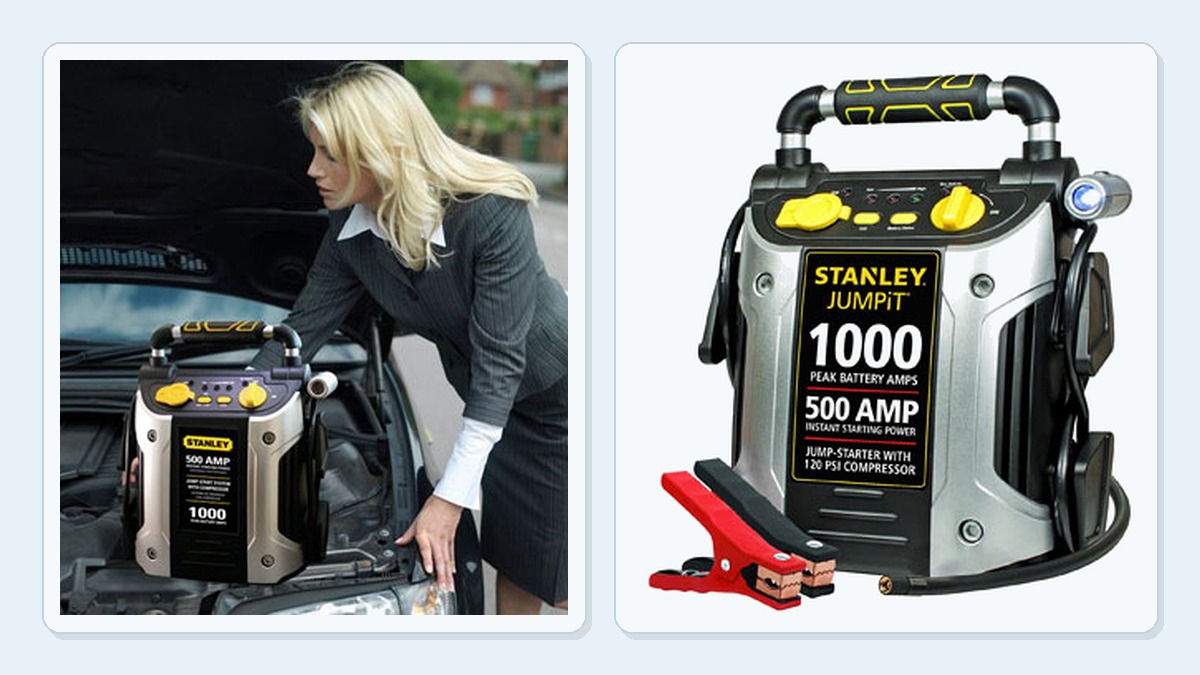
The original JumpStarterReviews page treated the J5C09 as a current product recommendation. That framing no longer meets our evidence standard. STANLEY's current U.S. catalogue supports newer power-station models, while we could not verify a current first-party J5C09 product page. This rebuild therefore preserves the useful protected URL without pretending an older model is newly current.
What changed since the original J5C09 review?
The basic idea has survived: one larger roadside unit can combine jump starting and tire inflation. What has changed is the product lineup. STANLEY currently publishes the PP1DCS as a 1,200-peak-amp power station with a 120 PSI compressor, USB charging, an LED work light and alternator-check capability.
That makes the J5C09 page more useful as an ownership and successor-context resource than as a fresh “buy this exact model” recommendation.
Evidence note: JumpStarterReviews has not physically tested the J5C09 or PP1DCS for this rebuild. Current-model details come from STANLEY's official U.S. catalogue. We do not carry old retailer specifications forward as if they were current manufacturer evidence.
If you already own a J5C09
An older jump starter deserves inspection before dependence. Check the case, cables, clamps and charging behavior. If the internal battery no longer holds useful charge, the fact that lights or a display still turn on does not establish that the unit can deliver starting power.
Keep using it only when
The unit is undamaged, charges normally, its instructions are available, and it remains suitable for the exact 12V vehicle and connection procedure you intend to use.
Replace or service it when
You see swelling, cracking, leakage, damaged cables or clamps, abnormal heat, unreliable charging or other signs that the unit is no longer serviceable.
The combo idea still makes sense for some drivers
A jump starter may be needed rarely, while a tire inflator can help with ordinary pressure corrections throughout the year. Combining both functions can make a larger emergency unit easier to justify.
The trade-off is that combination units are bulkier than many lithium jump packs, and aging or failure can affect more than one part of your emergency kit. Separate tools let you choose and replace each function independently.
| Combination power station | Separate tools |
|---|---|
| One unit to store and remember | Each tool can be optimized for its job |
| Jump starting plus tire inflation | Compact lithium jump packs can be much smaller |
| Shared charging/readiness routine | Failure of one tool does not remove the other |
| Often adds lights or device power | Easier to upgrade one component at a time |
Do not choose by peak amps or compressor PSI alone
Peak-amp claims are not a universal cross-brand performance standard, and maximum compressor pressure does not tell you how quickly a tire will inflate. Those numbers need context.
For a jump starter, consider vehicle compatibility, cable and clamp usability, internal battery condition, temperature and the manufacturer's operating limits. For an inflator, consider the pressure your vehicle actually requires, inflation time, gauge usability and any required cooling periods.
Quick Car Tip
Use the vehicle manufacturer's tire-pressure placard for normal inflation pressure, not the maximum pressure printed on the tire sidewall.
What a current STANLEY alternative looks like
STANLEY's current PP1DCS shows how the category has evolved. The company specifies 500 starting amps / 1,200 peak amps, 24-inch heavy-duty clamps, a 120 PSI compressor with automatic stop, four USB charging ports, an LED work light and alternator-check capability.
That does not make the PP1DCS an automatic recommendation for every reader. It simply gives today's shopper a verified current STANLEY reference point instead of sending them toward an older J5C09 listing whose exact status we cannot confirm from STANLEY's present catalogue.
Compatibility comes before features
These conventional STANLEY power-station jump-starting functions are for compatible low-voltage vehicle systems. Confirm the vehicle's system and approved jump-start points before connecting any unit.
Critical voltage rule
Never assume that a familiar-looking battery or set of terminals makes a jump starter compatible. Confirm the required low-voltage system and the manufacturer's jump-start procedure for the exact vehicle. If the voltage or approved connection points are uncertain, stop and check the owner's manual.
Hybrids and EVs need vehicle-specific instructions
A hybrid or EV can contain a high-voltage traction system plus a separate low-voltage electrical system. A conventional jump starter is not a traction-battery charger. Some vehicles permit low-voltage support or jump starting at designated points, but the exact manufacturer procedure controls.
Stop before connecting when
- the battery or power station is swollen, leaking, cracked or abnormally hot;
- you cannot confirm the correct system voltage;
- the clamps or cables are damaged;
- you cannot identify the approved connection points; or
- the vehicle instructions prohibit or materially change the normal procedure.
Buying an older J5C09 listing today
Age changes the buying decision. An old-stock or used jump starter contains an internal battery whose history may be unknown. Storage conditions, time without charging and previous use can matter even if the outside of the unit looks excellent.
For that reason, we would not pay a premium for an old J5C09 merely because a marketplace listing calls it “new.” A verified current model with current support and clearly stated specifications is generally the cleaner purchase unless there is a specific reason to seek the older unit.
Before you depend on any combination unit
Read the exact model's manual, learn your vehicle's approved jump points, verify the unit charges normally and try the non-emergency functions before a trip. STANLEY's support site advises owners to locate manuals by exact model number, which is especially important when several similar-looking power stations exist.
Bottom line
The J5C09 helped represent a useful all-in-one idea, but this page should no longer pretend that an older product is automatically today's best STANLEY purchase. Current STANLEY power stations continue the jump-starter-plus-compressor concept with models the manufacturer actively documents today.
If you already own a healthy J5C09, focus on condition, charge readiness and correct 12V use. If you are buying now, compare verified current combination units rather than chasing an old model number simply because an old review ranked it highly.
How JumpStarterReviews handles evidence
This page has been substantively rebuilt using STANLEY's current U.S. product catalogue and support guidance. We could not verify a current first-party J5C09 catalogue page, so we do not label the exact J5C09 as a current model or reproduce old merchant claims as current specifications. JumpStarterReviews has not physically tested either model for this rebuild.